WeatherNext 3 Uses Live Satellite Data to Deliver Sharper AI Weather Predictions Across Google
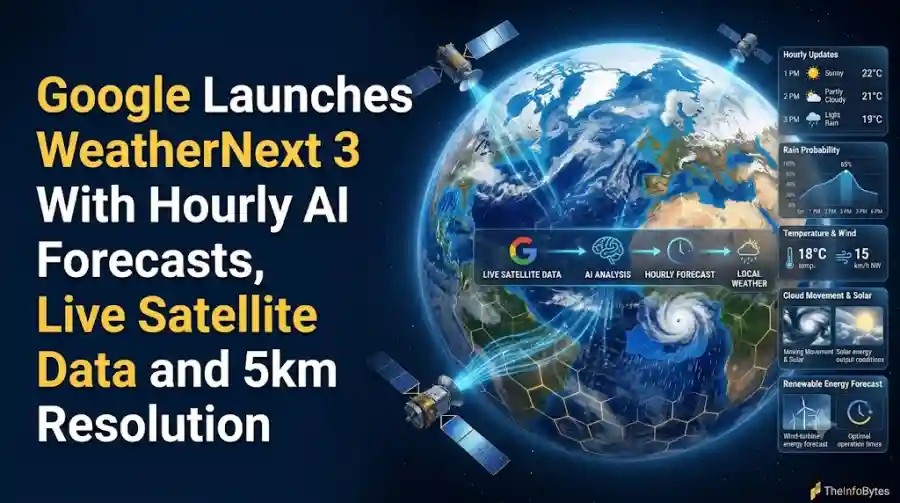
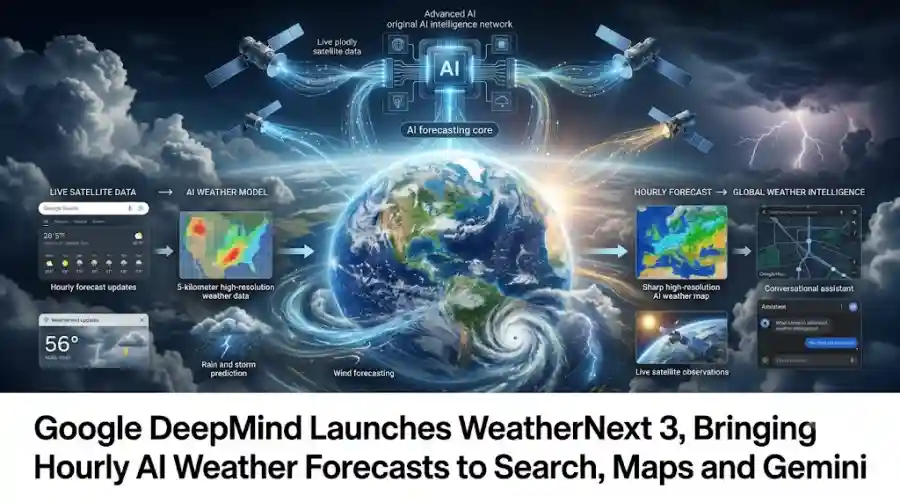
The announcement was made on September 3, 2026. WeatherNext 3 uses real-time satellite observations, refreshes forecasts every hour and can produce some surface-level forecasts at up to 5-kilometer resolution. Google says the model is its most advanced and accurate global weather AI model to date.
The launch is especially important because WeatherNext 3 is not staying inside a research lab. Google says it is beginning to power weather experiences across Google Search, the Gemini app, Google Maps, Google Maps Platform and Google Cloud.
This means AI weather forecasting could become a much more visible part of everyday Google products.
The new model also shows another important direction for artificial intelligence. AI is no longer focused only on chatbots, image generation, coding and agents. It is increasingly being used to solve large scientific and real-world prediction problems.
What Is Google WeatherNext 3?
WeatherNext 3 is Google's latest global AI weather forecasting model.
It was developed by Google DeepMind and Google Research to improve how weather predictions are generated and updated. Instead of relying only on the traditional approach of running complex physics simulations on supercomputers, WeatherNext 3 learns from large amounts of weather data and incorporates real-time observations.
The result is a system designed to generate forecasts more frequently and at higher resolution.
How WeatherNext 3 Works
Google says WeatherNext 3 ingests live global geostationary satellite data alongside other weather information.
The model receives a continuously updated view of atmospheric conditions and can generate a new forecast every hour.
This is a major change from WeatherNext 2, which produced forecasts on a 25-kilometer grid in six-hour increments.
WeatherNext 3 can generate key surface-variable forecasts at up to 5-kilometer resolution, while other surface and atmospheric variables are produced at different resolutions. Overall, Google says the new model provides a weather picture roughly five times sharper than its predecessor.
Why Real-Time Satellite Data Matters
Weather conditions can change quickly.
Rain systems can form and move rapidly. Storms can develop within a short period. Temperature and humidity can also vary significantly between locations.
Traditional numerical weather prediction systems depend heavily on physics-based simulations and structured atmospheric analyses. Google says these systems can involve a data lag that is particularly challenging for fast-changing conditions.
WeatherNext 3 attempts to reduce this problem by using a mosaic of live satellite observations.
This allows the AI model to receive newer information about the atmosphere and refresh its forecasts every hour.
WeatherNext 3 Delivers Hourly Forecast Updates
One of the biggest improvements in WeatherNext 3 is forecast frequency.
The model generates updated forecasts every hour.
From Six-Hour Updates to Hourly Predictions
WeatherNext 2 generated forecasts in six-hour increments at a 25-kilometer resolution.
WeatherNext 3 moves to an hourly refresh cycle and improves the level of detail available for several forecast variables.
That combination could be useful for situations where weather conditions change quickly.
A more frequently refreshed forecast can potentially provide users and businesses with a newer picture of atmospheric conditions than a system relying on less frequent updates.
Google says the model is designed to make rapidly changing weather easier to track at a global scale.
Higher Resolution for Local Weather Patterns
WeatherNext 3 can forecast key surface variables, including temperature and moisture, at up to 5-kilometer resolution.
Other surface variables are forecast at 10 kilometers, while atmospheric variables such as wind speed can be represented at 25 kilometers.
This matters because weather does not behave identically across large areas.
Topography, coastlines and local environmental conditions can create significant differences over relatively short distances.
The higher-resolution approach is intended to capture more of those local variations.
Google Claims Major Improvements in Rain Forecasting
Precipitation remains one of the most difficult areas of weather forecasting.
Rain and snow can be influenced by fast-moving and highly localized atmospheric processes.
Google says WeatherNext 3 has made significant improvements in this area.
Better Precipitation Data
The company says the model was trained using high-quality precipitation information, including NASA's Integrated Multi-satellite Retrievals for GPM, known as IMERG, along with Google's precipitation reanalysis work.
Google reported improvements in medium-range global precipitation forecasting when measured against several baselines.
According to the company, evaluations showed improvements of up to 60% against IMERG, 30% against MRMS and 10% against rain-gauge measurements for early lead times. These figures are specific to the evaluation methods and baselines described by Google.
Up to 50% More Accurate Precipitation Forecasts
For users planning at least a day ahead, Google says WeatherNext 3 can provide up to 50% more accurate precipitation forecasts in supported Google experiences.
The company says the improvements are particularly meaningful in regions where weather forecasting has historically been less reliable.
This could make the technology useful for daily planning, travel, agriculture and outdoor activities.
However, Google also advises users to rely on official meteorological agencies and national weather services for official forecasts, severe-weather warnings and public-safety advisories.
WeatherNext 3 Is Coming to Google Search, Maps and Gemini
WeatherNext 3 is not only a research project.
Google is integrating the model's weather intelligence into several major products.
Weather Information in Google Search
Google says WeatherNext 3 will begin powering weather experiences in Google Search.
This means users searching for weather-related information may benefit from the model's more frequently updated and higher-resolution forecasting data.
For Google, this is an example of an AI model moving directly into a product used by billions of people.
WeatherNext 3 in Google Maps
Google Maps will also begin receiving WeatherNext 3-powered weather information.
Weather conditions can influence travel, commuting and route planning, making improved weather intelligence potentially useful inside mapping services.
Google is also integrating the model with the Google Maps Platform Weather API, allowing developers and businesses to use weather information in their own applications and services.
Gemini Gets More Advanced Weather Intelligence
The Gemini app is another major destination for WeatherNext 3.
This could make Google's AI assistant more useful for weather-related questions by connecting conversational AI with a newer forecasting system.
The broader significance is important.
AI assistants are increasingly becoming interfaces for accessing specialized AI systems.
A user may ask a simple question, while the answer is supported by dedicated technology built for a particular domain.
In this case, Gemini can become another way for users to access Google's advanced AI weather intelligence.
WeatherNext 3 Could Help Clean Energy Planning
Weather forecasting is important far beyond deciding whether to carry an umbrella.
WeatherNext 3 introduces predictions specifically designed to support renewable-energy planning.
Wind Forecasts for Turbine-Height Conditions
Google says the model can forecast wind speeds at approximately 100 meters, which is relevant to wind turbines.
More accurate wind forecasts could help energy operators estimate potential power generation.
This is important because renewable-energy production depends heavily on changing environmental conditions.
A better understanding of expected wind conditions can support planning and grid management.
Solar Energy Forecasting
WeatherNext 3 also includes variables related to cloud cover and solar radiation.
These can help solar-energy operators estimate how much sunlight may reach the ground.
The ability to forecast these conditions can support decisions around expected energy generation and demand.
This gives WeatherNext 3 a practical AI use case beyond consumer weather information.
Why WeatherNext 3 Matters for AI
WeatherNext 3 represents a different type of AI progress.
Much of the public conversation around AI focuses on chatbots and generative models.
But machine learning is also increasingly being used to solve scientific prediction problems.
AI Is Moving Further Into Real-World Systems
An AI chatbot generates or analyzes information.
A weather model attempts to predict a changing physical system.
These are very different challenges.
WeatherNext 3 shows how AI can become part of systems used for:
- Agriculture
- Renewable energy
- Transportation
- Emergency planning
- Supply chains
- Research
- Travel
- Daily decision-making
The model's integration into Google products also demonstrates how specialized AI systems can eventually reach ordinary users without requiring them to understand the underlying technology.
Faster Forecasting Could Expand AI's Role
Traditional weather forecasting requires major computing infrastructure and complex physics simulations.
AI models can potentially generate forecasts much faster after training.
The goal is not necessarily to replace every traditional forecasting system.
Instead, AI can become another powerful layer in the forecasting ecosystem.
Google's approach with WeatherNext 3 combines AI methods with observational and historical weather information to improve forecasting detail and frequency.
WeatherNext 3 and Regions With Limited Forecasting Infrastructure
Google says higher-resolution forecasting can be particularly valuable in regions that have historically been underserved by expensive regional weather-computing infrastructure.
A Global AI Forecasting Model
Traditional high-resolution forecasting can require substantial supercomputing resources.
That can make it difficult to provide the same level of localized forecasting everywhere.
WeatherNext 3 is designed as a global model that can produce high-resolution predictions across large areas.
Google specifically highlighted potential benefits for regions across Latin America, Africa and Asia-Pacific.
This is an important part of the story because improved AI forecasting could potentially make more detailed weather intelligence accessible across regions where traditional high-resolution infrastructure is less available.
How Developers and Researchers Can Access WeatherNext 3 Data
Google is also making WeatherNext 3 useful beyond its consumer products.
Access Through Google Cloud
Google says high-resolution WeatherNext 3 forecasts are available for researchers, developers and businesses through its cloud ecosystem.
The company says users can query relevant data through BigQuery and Google Earth Engine or access data through Google Cloud Storage.
This means WeatherNext 3 could support applications built by organizations outside Google.
Potential uses could include research, agriculture analysis, logistics planning and energy forecasting, depending on the data and product access available.
What Are the Limitations of AI Weather Forecasting?
Despite the progress, AI cannot make weather perfectly predictable.
The atmosphere is a highly complex and changing system.
Forecasts Still Have Uncertainty
Every weather forecast contains uncertainty.
Small changes in atmospheric conditions can produce different outcomes over time.
Higher resolution and more frequent updates can improve the information available, but they do not eliminate uncertainty.
Google itself notes that the atmosphere will always retain a degree of unpredictability.
AI Forecasts Are Not a Replacement for Official Warnings
WeatherNext 3 should also not be treated as a replacement for official emergency information.
Google explicitly says users should refer to local meteorological agencies or national weather services for official forecasts, severe-weather warnings and public-safety advisories.
This is particularly important during cyclones, severe storms, floods and other dangerous weather events.
What WeatherNext 3 Means for the Future of AI Forecasting
WeatherNext 3 suggests that the future of AI may involve more specialized systems working behind everyday products.
Users may not need to open a separate AI tool or understand machine-learning terminology.
They could simply use Search, Maps or Gemini.
Behind those products, specialized AI models could process complex information and provide more useful answers.
Specialized AI Models Could Become More Common
The AI industry has spent years building general-purpose models.
The next stage may increasingly involve specialized AI systems designed for particular problems.
Examples could include AI for:
- Weather forecasting
- Scientific research
- Biology
- Energy planning
- Cybersecurity
- Software engineering
- Robotics
These systems can then connect with general-purpose AI assistants.
A user asks one question.
The assistant determines what information or specialized model is needed.
The underlying systems handle the complex work.
WeatherNext 3 provides a clear example of this direction.
Google DeepMind's WeatherNext 3 is one of the most interesting recent AI launches because it takes artificial intelligence into a highly practical scientific field.
The model uses real-time satellite observations, generates updated forecasts every hour and provides much higher spatial detail than WeatherNext 2 for key forecast variables.
Google says WeatherNext 3 can provide a weather picture roughly five times sharper than its previous model and improve precipitation forecasting for users planning ahead.
Its integration into Google Search, Maps, Gemini and cloud products also means the technology could quickly reach a large number of users and developers.
The launch also highlights a broader AI trend.
The future of AI may not only be about bigger chatbots.
It may increasingly be about specialized systems that solve difficult real-world problems and quietly power the products people already use.
For WeatherNext 3, the goal is simple but technically ambitious:
Use AI and real-world observations to provide a more detailed and frequently updated picture of what the weather may do next.
FAQs
What is Google WeatherNext 3?
Google WeatherNext 3 is an AI-powered global weather forecasting model developed by Google DeepMind and Google Research. It uses real-time observations and produces updated forecasts every hour.
When was WeatherNext 3 launched?
Google announced WeatherNext 3 on September 3, 2026.