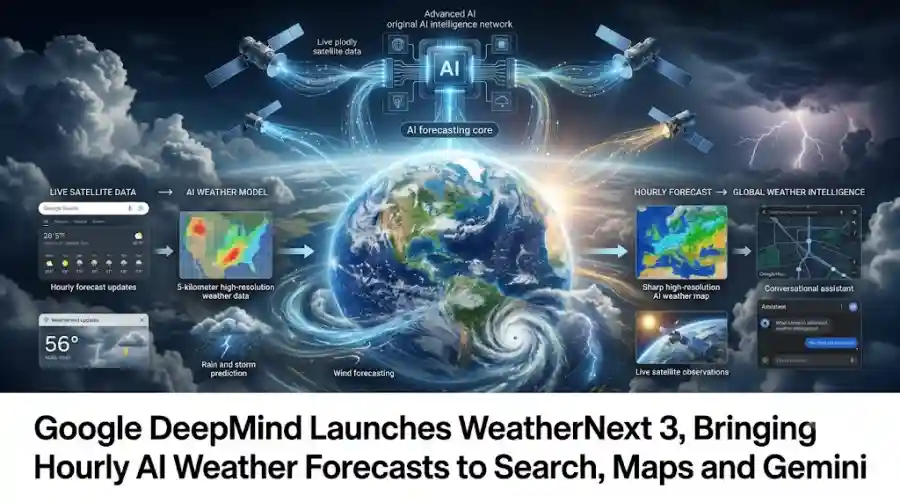
Google WeatherNext 3 Brings More Accurate AI Weather Forecasts to Search, Gemini and MapsAnnounced on September 3, 2026 by Google DeepMind and Google Research, WeatherNext 3 is designed to generate more localized and frequently updated forecasts using real-time satellite observations.
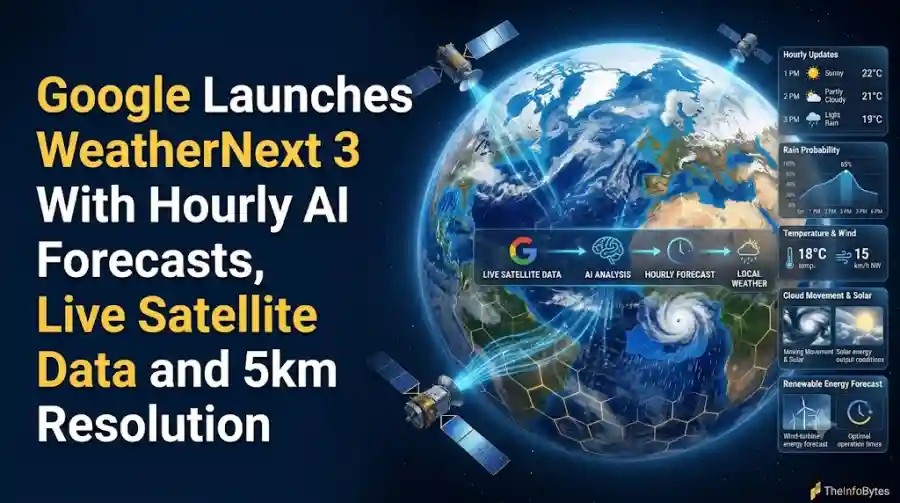
Google says the model can produce a new forecast every hour and reach resolutions as detailed as 5 kilometers for some surface variables.
That represents a major improvement over WeatherNext 2, which generated predictions on a 25-kilometer grid at six-hour intervals.
WeatherNext 3 is not being kept inside a research laboratory either.
Google has started integrating the technology into Google Search, the Gemini app, Google Maps, Google Maps Platform Weather API and Google Earth Engine, while making forecast data available to developers and researchers through Google Cloud services.
For users, the result could be more detailed weather information.
For developers and businesses, WeatherNext 3 could become an important new source of AI-generated weather intelligence.
What Is Google WeatherNext 3?
WeatherNext 3 is Google's latest artificial intelligence model for global weather prediction.
It uses machine learning to forecast atmospheric conditions rather than depending exclusively on the traditional numerical weather prediction approach that uses large physics simulations on supercomputers.
Google describes WeatherNext 3 as its most advanced and accurate global AI weather model so far.
How WeatherNext 3 Differs From Earlier Models
One of the biggest differences is the type of information the system can consume.
Most previous AI weather systems, including WeatherNext 2, relied heavily on processed information from numerical weather prediction models.
Google says these traditional datasets can carry a delay of around six hours.
That delay can matter for rapidly changing conditions such as rainfall and surface temperature.
WeatherNext 3 can instead ingest continuously updated mosaics of global geostationary satellite observations.
This allows the system to work with much more recent information about atmospheric conditions.
WeatherNext 3 Generates Forecasts Every Hour
WeatherNext 3 is designed to generate an updated forecast every hour.
By comparison, Google's previous WeatherNext 2 system generated forecasts at six-hour intervals.
More frequent updates could become particularly useful when weather is changing quickly.
Storms, rainfall systems and temperature conditions can develop substantially within a few hours.
An AI model that receives newer observations more frequently can potentially respond faster to those changes.
WeatherNext 3 Brings Weather Forecasts Down to 5km Resolution
Higher spatial resolution is another major improvement.
Google says WeatherNext 3 can produce forecasts for key surface variables such as temperature and moisture at resolutions down to 5 kilometers.
Other surface variables can be predicted at around 10 kilometers, while atmospheric variables such as wind speed can use approximately 25-kilometer resolution.
WeatherNext 3 Is Five Times Sharper Than WeatherNext 2
Google describes the overall weather picture generated by WeatherNext 3 as roughly five times sharper than its previous model.
WeatherNext 2 operated mainly on a 25-kilometer grid.
WeatherNext 3's finer resolution can better represent local geographic features such as mountains, coastlines and valleys.
Those details are important because weather conditions can vary significantly across relatively short distances.
A forecast covering an entire large region may miss differences caused by local terrain.
Why More Local Weather Forecasts Matter
Higher resolution can be valuable for many real-world decisions.
Farmers may need information about rainfall around specific agricultural areas.
Airports need localized information about wind and precipitation.
Cities need forecasts for heat, storms and flooding.
Renewable-energy operators need accurate wind and cloud information around specific facilities.
WeatherNext 3 is designed to provide more of this localized weather intelligence.
WeatherNext 3 Uses Live Satellite Data
Perhaps the most important technical change is WeatherNext 3's use of real-time satellite observations.
Instead of relying exclusively on processed atmospheric datasets, the model can analyze mosaics created from global geostationary satellites.
Google says this gives WeatherNext 3 a continuously updated view of atmospheric conditions.
Why Satellite Observations Can Improve AI Weather Models
Satellite systems continuously monitor cloud patterns and atmospheric changes across enormous parts of the planet.
That makes them especially useful in areas where ground-based weather stations are limited.
Google says the approach could help improve forecasting in regions across Latin America, Africa and Asia-Pacific that have historically lacked access to highly detailed regional weather models because of the computing requirements involved.
That makes WeatherNext 3 relevant beyond markets where advanced forecasting infrastructure is already widespread.
The Model Also Learns From Weather Stations
Satellite observations are not the only source of real-world information used by WeatherNext 3.
Google says the system also trains directly using sparse weather-station observations.
That helps the model learn more localized conditions and account for geographic details.
Combining satellite information with station-level observations could help connect large-scale atmospheric patterns with what people actually experience locally.
WeatherNext 3 Improves Rain and Snow Forecasting
Precipitation prediction remains one of the most difficult parts of weather forecasting.
Rainfall and snowfall can develop rapidly and often involve weather processes occurring over relatively small areas.
Google says WeatherNext 3 includes significant improvements specifically designed to address this problem.
Google Reports Major Precipitation Accuracy Gains
Google evaluated the model against multiple precipitation datasets.
The company reports improvements in Continuous Ranked Probability Score of up to 60% against NASA IMERG data, around 30% against MRMS data and approximately 10% against rain-gauge measurements for early forecast periods.
TechCrunch also reported that WeatherNext 3's rainfall evaluations showed substantial improvement compared with WeatherNext 2.
These measurements are technical benchmarking results rather than a guarantee that every individual forecast will be correct.
Weather remains inherently uncertain.
Longer-Term Rain Forecasts Could Improve for Everyday Users
Google says people looking at forecasts a day or more in advance can see precipitation forecasts that are up to 50% more accurate, with some of the largest improvements expected in regions where weather predictions have traditionally been less reliable.
That could translate into more useful information when planning:
- Travel
- Outdoor events
- Agricultural work
- Construction
- Logistics
- Daily commuting
The actual benefit will depend on location and weather conditions.
WeatherNext 3 Is Coming to Google Search, Gemini and Maps
WeatherNext 3 is unusual because Google is immediately connecting the research model to products used by millions of people.
The company says the model is beginning to power weather experiences across its wider ecosystem.
Google Search
Weather information displayed through Google Search can begin using WeatherNext 3 forecasts.
Users may therefore benefit from the new model without needing to interact with a separate AI weather application.
Gemini App
Google is also integrating WeatherNext 3 into the Gemini app.
This could make weather-related questions more useful when users ask Gemini about travel, outdoor activities or future conditions.
The important point is that the weather intelligence comes from Google's specialized forecasting system rather than Gemini simply generating a prediction from general language-model knowledge.
Google Maps
Google Maps will also use WeatherNext 3 data.
Weather information inside a mapping application can be particularly useful for travel and route planning.
Weather can influence road conditions, outdoor activities and transportation decisions.
Google Maps Platform Weather API
Developers building mapping and location-based applications can access weather capabilities through Google Maps Platform.
This creates potential uses for travel applications, logistics platforms, delivery systems and location-aware services.
Developers Can Build With WeatherNext 3 Data
WeatherNext 3 is not restricted to Google's consumer products.
Google is also making high-resolution forecast data available for developers, researchers and businesses.
WeatherNext 3 Data Through Google Cloud
Google says forecast data can be queried through BigQuery and Earth Engine or downloaded in bulk through Google Cloud Storage.
This is important because businesses do not necessarily need to train or operate the weather model themselves.
They can use generated forecast data inside their own workflows.
Possible Developer Use Cases
WeatherNext 3 could potentially support applications in:
- Agriculture
- Logistics
- Transportation
- Aviation
- Travel
- Insurance
- Emergency planning
- Energy management
- Weather applications
- Supply-chain operations
The value comes from turning weather forecasts into operational decisions.
WeatherNext 3 Adds Special Forecasts for Renewable Energy
Google has also designed parts of WeatherNext 3 specifically for clean-energy applications.
This is an important feature because renewable-energy generation depends heavily on weather.
Wind Energy Forecasting
WeatherNext 3 can forecast wind speeds at approximately 100 meters above ground, which is around the height where many wind turbines operate.
Better wind forecasts could help operators estimate how much electricity wind farms are likely to produce.
Solar Energy Forecasting
The model can also forecast high-resolution cloud cover and solar radiation.
Solar farms need this information because cloud conditions strongly influence electricity production.
More reliable forecasting can help grid operators estimate how much renewable electricity will be available and balance that generation against demand.
Why AI Weather Forecasting Is Becoming Important
Weather forecasting has traditionally depended on complex numerical models that simulate atmospheric physics on powerful supercomputers.
Artificial intelligence offers another approach.
AI systems can learn patterns from historical and observed atmospheric data and generate forecasts far more quickly.
AI Does Not Completely Replace Traditional Forecasting
WeatherNext 3 should not be interpreted as evidence that conventional meteorology is no longer necessary.
Google itself warns users to rely on their official local meteorological agency or national weather service for severe-weather alerts and public-safety information.
AI forecasts can complement established weather systems rather than completely replacing them.
Competition in AI Weather Models Is Growing
Google is not alone in developing AI-based weather forecasting technology.
Startups, researchers and other technology companies are exploring similar approaches.
TechCrunch noted that Google's claim around incorporating raw observations exists within a competitive and rapidly developing AI-weather field.
That competition could accelerate improvements in forecasting speed and resolution.
What Are the Limitations of WeatherNext 3?
WeatherNext 3 represents a major technical improvement, but no weather model can perfectly predict atmospheric conditions.
Weather Will Always Include Uncertainty
The atmosphere is an extremely complex system.
Small changes can affect future conditions, particularly over longer periods.
Google explicitly acknowledges that weather will always retain some level of unpredictability.
Users should therefore avoid interpreting an AI-generated forecast as a guarantee.
Official Alerts Still Matter
For dangerous weather conditions such as cyclones, severe storms, floods or heat emergencies, users should continue following official warnings from national and local authorities.
AI forecasting may improve information, but emergency guidance should come from authorized weather agencies.
What WeatherNext 3 Means for the Future of AI
WeatherNext 3 is important because it shows how AI is expanding beyond chatbots and content generation.
The model is solving a specialized scientific problem.
It processes enormous streams of observational data, predicts complex physical systems and turns those predictions into information people and businesses can use.
Specialized AI Models Could Become More Common
Much of the current AI industry focuses on large general-purpose language models.
WeatherNext 3 represents another direction.
Instead of creating one system designed to answer everything, companies can develop specialized AI models optimized for areas such as:
- Weather
- Biology
- Medicine
- Materials
- Climate
- Robotics
- Energy
- Scientific research
These systems may become some of the most valuable applications of artificial intelligence.
AI Is Moving Into Real-World Decision Systems
Accurate weather information influences agriculture, transportation, energy, emergency management and global supply chains.
That means AI forecasting models can affect decisions far beyond the technology industry.
WeatherNext 3 demonstrates how AI can move from generating digital content to supporting decisions involving physical infrastructure and the real world.
Google WeatherNext 3 is a significant upgrade to AI-based weather forecasting.
The model combines real-time satellite observations, hourly forecast updates and resolutions as detailed as 5 kilometers for some variables.
Google also says it delivers major improvements in precipitation forecasting and introduces specialized information for renewable-energy production.
More importantly, WeatherNext 3 is already moving into consumer products.
Google is integrating it across Search, Gemini, Maps, Google Maps Platform and Earth Engine while giving developers and researchers access to forecast data through its cloud infrastructure.
That makes WeatherNext 3 more than another experimental AI research model.
It is becoming part of Google's real-world product ecosystem.
The broader significance is also clear.
Artificial intelligence is expanding beyond writing assistants, image generators and chatbots.
Models are increasingly being built to understand complex systems such as weather and convert massive amounts of real-world data into useful predictions.
If those systems continue improving, specialized scientific AI could become one of the most important areas of artificial intelligence over the next several years.
Frequently Asked Questions
What is Google WeatherNext 3?
WeatherNext 3 is Google DeepMind and Google Research's latest global AI weather forecasting model. It uses real-time observations including satellite data to generate detailed weather predictions.
How often does WeatherNext 3 update forecasts?
Google says WeatherNext 3 can generate a new forecast every hour using recent observational data.