Salesforce’s New AI Harness Could Change How Enterprises Build and Manage AI Agents
An AI agent may need information from a CRM, ERP system, contracts, analytics platforms, company policies and previous customer interactions before it can safely answer a seemingly simple question. Connecting those systems is only part of the challenge. The AI also needs to understand the context, follow business rules, perform authorized actions and remain observable.
Salesforce is now addressing that problem with a new architecture called Enterprise AI Harness.
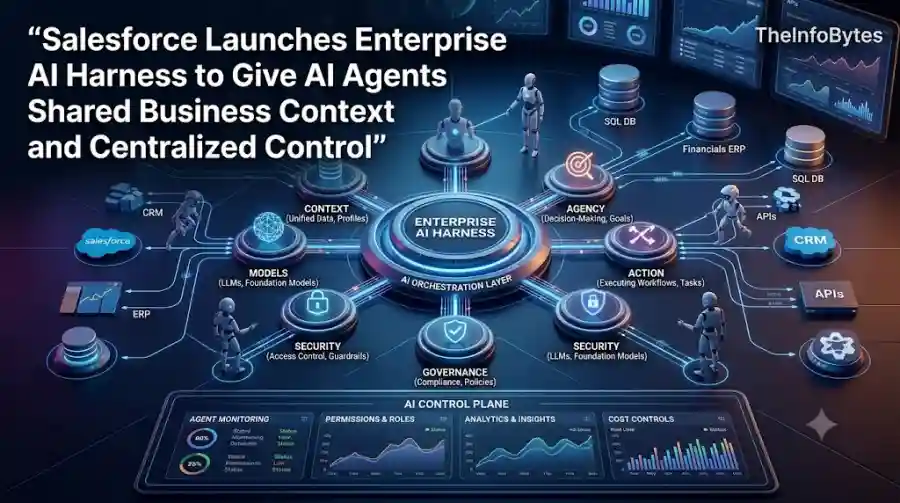
Announced on September 10, 2026, the system brings together six capabilities covering context, agency, action, governance, security and models. Salesforce is also introducing an AI Control Plane designed to give organizations a central way to manage AI agents and AI systems across the enterprise.
What Is Salesforce Enterprise AI Harness?
Salesforce describes Enterprise AI Harness as a trusted foundation around AI that allows agents to understand the business, reason and plan, take actions and operate within enterprise controls.
Instead of forcing companies to build these capabilities independently for every AI application or agent, Salesforce is combining them into a common architecture.
The important distinction is that this is not simply another AI model.
Salesforce is focusing on the infrastructure surrounding AI models and agents.
The architecture can use Salesforce technologies, existing enterprise technologies and third-party models, agents and systems. That makes the approach broader than a single-model AI platform.
The company says its Enterprise AI Harness is built around six trusted capabilities.
The Six Trusted Capabilities
Trusted Context
The first layer is Trusted Context.
Enterprise AI often struggles because business information is distributed across multiple systems. A CRM might contain customer information while an ERP system holds inventory data. Contracts, analytics, policies and previous conversations can contain additional information.
Trusted Context is designed to bring these different sources together with data, metadata, business semantics, knowledge, real-time signals and memory.
For an AI agent, this means having a more complete understanding of the customer and the business situation before making a decision.
Trusted Agency
The second capability is Trusted Agency.
This focuses on the reasoning and orchestration needed for more complex tasks.
Salesforce says it includes capabilities for reasoning, planning, state, memory, collaboration and orchestration. It is designed to combine flexible AI reasoning with deterministic controls when businesses require predictable behavior.
That distinction could become increasingly important as companies allow agents to perform tasks rather than simply provide recommendations.
Trusted Action
Understanding what needs to happen is not enough for an enterprise agent.
The agent must also be able to execute the task.
Trusted Action connects AI agents with applications, APIs, workflows, tools and business processes.
Salesforce gives the example of an agent determining whether an order can be fulfilled and then potentially reserving inventory, updating the order, triggering fulfillment or involving a human when necessary.
This is where enterprise AI moves from answering questions toward actually participating in business operations.
Trusted Governance
The fourth layer is Trusted Governance.
AI systems depend heavily on the quality and reliability of the information they use. Businesses also need policies governing how that information can be processed and what agents are allowed to do.
Trusted Governance is designed around data and metadata governance, lineage, quality, guardrails and controls.
The goal is to make sure agents operate using trusted information while following the organization's policies.
Trusted Security
Security becomes even more important when AI agents can take actions.
Trusted Security applies identity, permissions, privacy, data protection and runtime security to AI operations.
This is intended to control what an agent can access and which actions it is authorized to perform.
That could be particularly important as enterprises begin operating multiple agents across different departments and applications.
Trusted Models
The sixth capability is Trusted Models.
Salesforce does not want enterprises to be locked into one model.
The company says its architecture can connect organizations with different AI models and use intelligent model routing based on factors such as accuracy, performance, cost and business requirements.
That gives enterprises more flexibility as AI models continue to change.
Instead of rebuilding an entire AI application whenever a better model appears, businesses could potentially change the intelligence layer while retaining their surrounding enterprise context, controls and workflows.
Salesforce Introduces an AI Control Plane
One of the most significant parts of the announcement is the new AI Control Plane.
As organizations deploy more AI agents, simply having individual agent dashboards may not be enough.
Companies need to know:
- Which AI agents are operating?
- What systems can they access?
- Which policies apply to them?
- How are they performing?
- What actions are they taking?
- What are those actions costing the company?
Salesforce says the AI Control Plane will provide a central location for discovering and registering agents and AI capabilities, establishing identity and policies, managing lifecycles, evaluating performance, monitoring behavior and outcomes, and controlling costs.
Importantly, this management layer is designed to cover Salesforce and third-party AI systems.
That makes the Control Plane potentially useful in organizations where AI is coming from multiple vendors rather than a single platform.
Salesforce Is Taking an Open Approach
Salesforce is also positioning Enterprise AI Harness as a composable and open architecture.
The company says its capabilities are being made accessible through technologies including MCP, APIs, Skills and Plug-ins.
The architecture is intended to extend beyond traditional Salesforce applications and work across AI experiences and business software, including Claude, Slack, Microsoft Teams and Agentforce.
This approach reflects a broader change in enterprise AI.
Businesses are unlikely to use only one AI model or one AI application. Instead, companies may have several models, specialized agents and different AI-powered applications operating simultaneously.
A common control and context layer could therefore become increasingly valuable.
Why Enterprise AI Harness Matters
The biggest idea behind Salesforce's announcement is that the AI model itself may not be the most important enterprise asset.
Models are changing rapidly. New models can offer better reasoning, lower costs or faster inference.
But a company's customer information, business processes, historical interactions, permissions, policies and operational knowledge are much more specific to that organization.
Salesforce argues that this proprietary context can become a long-term source of differentiation.
The Enterprise AI Harness is designed to make that context available to AI while connecting it with the controls required to operate safely.
This is also where the announcement differs from another model-launch story.
Salesforce is effectively focusing on the system around the AI agent, rather than only the intelligence inside the agent.
When Will Salesforce Enterprise AI Harness Be Available?
Salesforce says many of the technologies forming the foundation of Enterprise AI Harness are already available.
However, the new capabilities and unified experience are planned to begin rolling out in early fiscal FY28.
The company has not yet finalized all availability, packaging, pricing and upgrade details. Existing customers will be able to upgrade eligible Salesforce investments as new capabilities become available.
That means businesses should not treat every component described in the announcement as generally available today.
Salesforce is still developing parts of the broader architecture.
What It Means for the Future of Enterprise AI
AI agents are becoming more capable, but capability alone does not solve the enterprise deployment problem.
An agent that can reason but cannot access the right information is limited.
An agent that can access information but cannot securely perform actions is also limited.
And an agent that can perform actions without strong governance, identity and monitoring can create significant operational risk.
Salesforce's Enterprise AI Harness attempts to address these problems together.
Its six-layer approach combines business context, agent reasoning, actions, governance, security and model flexibility, while the AI Control Plane adds centralized visibility and management.
For companies moving from AI experimentation toward large-scale agent deployment, that architecture could become more important than simply choosing the newest AI model.
The larger shift is clear: enterprise AI is moving from AI that answers toward AI that understands, decides and acts inside business systems.
The infrastructure controlling those actions may become one of the most important parts of the next phase of the AI industry.
FAQs
What is Salesforce Enterprise AI Harness?
Salesforce Enterprise AI Harness is a new enterprise AI architecture designed to give AI agents shared business context, reasoning capabilities, secure actions, governance, security and model flexibility.
What are the six capabilities of Enterprise AI Harness?
The six capabilities are Trusted Context, Trusted Agency, Trusted Action, Trusted Governance, Trusted Security and Trusted Models.