DataCebo SDV 2.0 Turns Enterprise Databases Into Generative Models for Synthetic Data and AI Agents
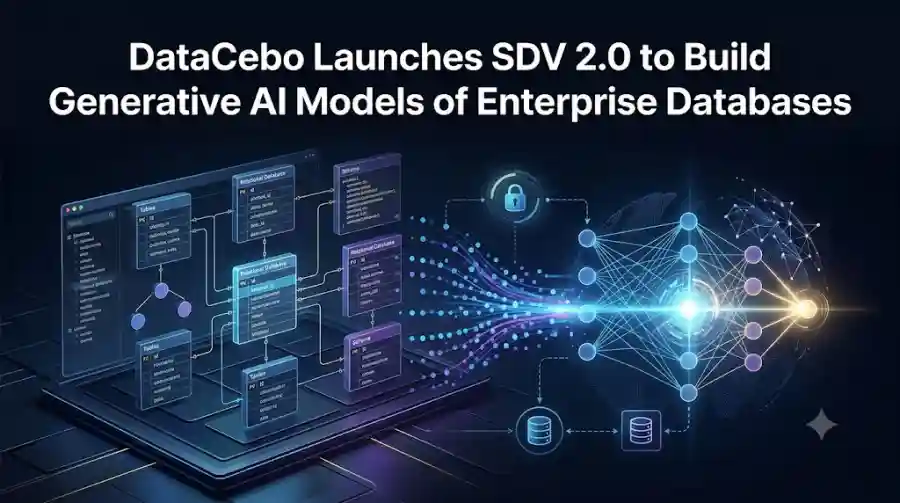
Instead of treating individual tables as isolated datasets, SDV 2.0 is designed to learn a database as a connected system, including relationships between tables, data structures, context and business rules.
The resulting model can then be used to generate synthetic datasets, simulate scenarios, and train or evaluate AI agents without requiring production data to leave the organization's controlled environment.
What Is DataCebo SDV 2.0?
SDV 2.0 is the latest release of DataCebo's enterprise synthetic-data technology.
The core idea is relatively simple: instead of repeatedly copying pieces of production data for different development and testing tasks, an organization can create a generative model that represents the behavior and relationships contained within its databases.
DataCebo describes these as generative relational models, or GRMs.
According to the company, the models are trained from scratch using an organization's data and can learn statistical patterns, database structures, relationships, context and business rules spanning multiple tables.
This is important because enterprise databases are rarely just collections of independent spreadsheets.
A customer database may connect to orders, payments, products, support tickets and other records. Simply generating realistic rows for one table does not necessarily produce a dataset that behaves like the original database.
SDV 2.0 is designed around that relational problem.
How SDV 2.0 Works
DataCebo says organizations can build a generative relational model using a representative subset of their data.
The training process takes place within infrastructure controlled by the organization. The company says that, depending on the database, model creation can typically take from minutes to around an hour.
The software can automate several parts of the setup process.
Automatic Schema and Relationship Discovery
SDV 2.0 can identify database structures and relationships, including:
- Primary keys
- Foreign keys
- Composite keys
- Relationships between tables
- Data formats and context
- Business constraints
This reduces the amount of manual configuration required before generating synthetic data.
That matters for large enterprise databases, where hundreds of tables and thousands of columns can make manual modeling time-consuming.
Business Rules and Constraints
Real-world business data follows rules that random data generators cannot easily reproduce.
For example, relationships between customers and orders need to remain logically consistent. Certain transactions may only occur under particular conditions, while rare events may need to be represented for testing.
DataCebo says SDV 2.0 can detect and enforce business constraints while tuning its generative model.
The result is intended to be more useful for enterprise testing and simulation than simply generating random-looking records.
Task-Specific Synthetic Data
Another important feature is the ability to generate datasets for particular scenarios.
DataCebo says SDV 2.0 can generate task-specific datasets, including rare events and edge cases.
This could be useful for software testing and AI evaluation because teams often need unusual scenarios that may be difficult to obtain from a production environment.
Instead of waiting for a rare real-world event to occur, teams can potentially create synthetic examples based on the learned database model.
Why Synthetic Enterprise Data Matters for AI Agents
AI agents need more than general knowledge to perform useful enterprise work.
They often need context about customers, transactions, internal processes and business rules.
However, giving an external AI system unrestricted access to production databases can create security, privacy and compliance concerns.
SDV 2.0 is designed to provide another option.
DataCebo says organizations can use the resulting models to generate synthetic data and train and evaluate AI agents without moving or exposing production data.
This creates a potential workflow where development teams can test an AI agent against realistic synthetic enterprise scenarios before connecting it to sensitive production systems.
For example, an organization could generate synthetic customer transactions to evaluate an AI system's ability to detect unusual behavior, test a support workflow or validate an automated business process.
The synthetic data would not simply be random records. The goal is to preserve meaningful relationships and patterns learned from the original database.
Supported Enterprise Data Sources
DataCebo says SDV 2.0 can connect directly to several enterprise database technologies.
The announced integrations include:
- Oracle
- SQL Server
- BigQuery
- Spanner
- AlloyDB
The software runs within the customer's environment, according to DataCebo.
That architecture is particularly relevant for organizations that cannot freely transfer production data to external AI services.
DataCebo's existing SDV platform is also designed around keeping sensitive data within controlled environments, with its product documentation describing on-premises deployment and secure-environment workflows.
What Can Companies Use SDV 2.0 For?
DataCebo positions the technology as more than a synthetic-data generator.
Potential use cases include:
Software Testing
Development teams can generate realistic datasets without relying on production records.
This can make it easier to test applications against different database conditions while reducing dependence on sensitive customer information.
AI Agent Evaluation
Companies can create controlled scenarios for evaluating AI agents.
This could include normal workflows, unusual cases and edge conditions that would be difficult to reproduce safely with real production data.
Machine Learning Development
Synthetic datasets can provide development teams with additional data for experimentation without directly distributing sensitive records.
Scenario Simulation
Organizations can use generated data to simulate business conditions and investigate how software or AI systems behave under different circumstances.
Secure Data Sharing
Synthetic data can also help teams share realistic datasets while reducing the need to distribute production records.
DataCebo's broader SDV platform lists software testing, scenario planning, AI model training and data sharing among its synthetic-data applications.
SDV 2.0 Automates More of the Synthetic Data Workflow
One of the notable changes in SDV 2.0 is the move toward automation.
Earlier enterprise synthetic-data workflows could require teams to manually understand database relationships, configure schemas and define rules.
DataCebo says SDV 2.0 automates much of this discovery and setup.
When connected to a database or collection of files, the system can identify relationships, recognize formats and context, detect constraints, tune the model and generate datasets for specific scenarios.
That means the product is targeting not just data scientists but broader enterprise teams dealing with complex databases.
DataCebo's Existing Synthetic Data Ecosystem
SDV 2.0 builds on the larger Synthetic Data Vault ecosystem.
DataCebo says SDV originated from research at MIT's Data to AI Lab and has grown into an ecosystem containing synthetic-data libraries, evaluation tools and benchmarking projects.
The open-source SDV project supports single-table, multi-table and sequential synthetic-data generation, while its broader ecosystem includes tools for evaluating generated datasets.
DataCebo says SDV has surpassed 18 million downloads and has been cited in more than 5,000 research papers, with more than 30,000 data scientists using the ecosystem. These figures are company-reported.
SDV 2.0 Pricing
DataCebo says SDV 2.0 is available now.
The company's announced self-service, consumption-based pricing starts at $500 per month for unlimited tables.
This puts SDV 2.0 firmly in the enterprise software category rather than the typical consumer AI-tool market.
Organizations evaluating the platform will therefore need to consider their database architecture, security requirements and synthetic-data workloads alongside the subscription cost.
Why This Launch Matters for Enterprise AI
The AI industry has spent much of 2026 focused on increasingly capable agents and models.
SDV 2.0 addresses a different part of the AI stack: the data that enterprise AI systems need to work effectively.
Large language models can provide general reasoning and language capabilities, but enterprise applications often depend on proprietary operational data.
DataCebo's approach is to create a generative representation of that data so organizations can use synthetic versions of their databases for development, testing and AI evaluation.
That does not eliminate the need for secure production-data controls. Instead, it offers another layer between sensitive production systems and development or AI experimentation.
For companies building AI agents around complex databases, that distinction could become increasingly important.
DataCebo's SDV 2.0 is a notable development in the synthetic-data space because it moves beyond generating isolated fake records.
Its central idea is to create a generative model of an entire relational database, preserving the connections, structures and rules that make enterprise data useful.
The company says organizations can use these models for synthetic data generation, scenario simulation, software testing and AI-agent training and evaluation while keeping production data inside their own controlled infrastructure.
As enterprises deploy more AI agents, the ability to test those systems against realistic business scenarios without repeatedly exposing production data could become an increasingly important part of the AI development stack.
Related TheInfoBytes AI Tools coverage:
Official sources:
DataCebo SDV 2.0 announcement
DataCebo SDV platform
DataCebo SDV ecosystem
Frequently Asked Questions
What is DataCebo SDV 2.0?
DataCebo SDV 2.0 is enterprise software designed to build generative relational models of an organization's databases for synthetic data generation, scenario simulation and AI-agent training and evaluation.
What are generative relational models?
Generative relational models are models designed to learn the structure, relationships, statistical patterns and business rules across connected enterprise database tables.