WSO2 Makes Agent Manager Generally Available to Govern, Secure and Manage AI Agents Across Any Framework
WSO2 is addressing that problem with the general availability of WSO2 Agent Manager 1.0, an open control plane designed to manage AI agents across different frameworks, models and deployment environments.
WSO2 announced general availability on September 15, 2026, describing Agent Manager as a way for enterprises to secure, operate and manage their entire agent estate while avoiding dependence on one AI framework or model provider.
The platform is available under the Apache 2.0 license and can be deployed as self-hosted infrastructure or used through managed SaaS offerings.
What Is WSO2 Agent Manager?
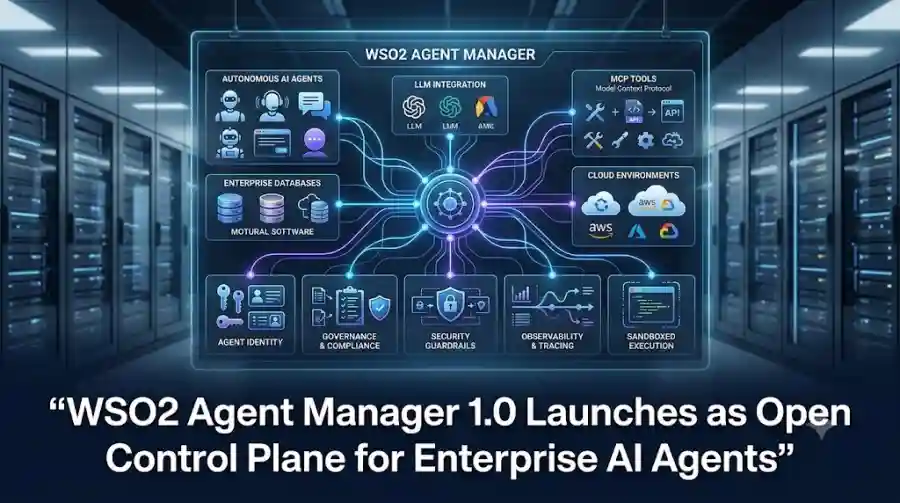
WSO2 Agent Manager is designed to act as a central management layer for AI agents.
Instead of requiring each team to build its own security, monitoring and governance infrastructure around every agent, the platform provides centralized capabilities for:
- Agent deployment
- Agent identity
- Access control
- Guardrails
- Runtime management
- Observability
- Agent evaluation
- MCP governance
- Lifecycle management
- Policy enforcement
WSO2 says the system can manage agents regardless of the framework used to build them and can also register agents running in external environments.
That framework-agnostic approach is important because enterprise AI environments are rarely built around a single technology stack.
One team might use LangGraph, another might use CrewAI, while other applications could run through cloud-specific agent platforms.
Agent Manager is intended to provide a common control layer across those environments.
Why Enterprises Need an Agent Control Plane
Managing traditional software is already a complex process.
AI agents introduce additional challenges because they can make decisions, call tools, access data and perform actions dynamically.
An enterprise may therefore need to answer questions such as:
- Which agents are currently running?
- Who owns each agent?
- What model does it use?
- Which MCP servers can it access?
- What tools can it call?
- What data can it reach?
- What actions has it performed?
- How is its performance being measured?
- Can administrators stop or modify it?
- Can the organization trace an agent's decisions?
WSO2 argues that traditional application-management approaches do not fully address these requirements.
Its Agent Manager is designed specifically around the lifecycle of autonomous and semi-autonomous AI systems.
This becomes increasingly relevant as enterprises move AI agents from prototypes into production environments.
WSO2 Agent Manager Is Framework-Agnostic
One of the central features of Agent Manager is that organizations do not have to standardize every AI agent on one development framework.
WSO2 says Agent Manager can work with agents built using frameworks such as LangGraph and CrewAI, while also supporting agents from other frameworks and environments.
The platform is also designed to work across different deployment models.
Organizations can run their infrastructure:
- On-premises
- In private cloud environments
- In public cloud
- Through Kubernetes
- Through managed SaaS
This gives enterprises more control over where agent workloads and related data are processed.
For organizations with strict data-residency or sovereignty requirements, the self-hosted option can be particularly relevant.
Open Source and Open Standards Are Central to the Platform
WSO2 is positioning Agent Manager as an open alternative to tightly controlled proprietary agent-management systems.
The platform is released under the Apache 2.0 license, while WSO2 says it is built around open standards including MCP, A2A, OpenTelemetry, OAuth and Kubernetes.
The company says this approach is intended to reduce vendor lock-in.
For enterprises, the advantage is that their agent-management layer does not necessarily have to be tied to a particular model provider.
That could become increasingly important as organizations use multiple AI models simultaneously.
A company might use one model for reasoning, another for coding, another for document processing and specialized models for particular business workflows.
A centralized control plane can potentially manage these different systems without forcing every application into the same model ecosystem.
Agent Identity Gives AI Systems Their Own Access Controls
AI agents create a particularly difficult identity problem.
An agent may perform actions on behalf of an employee, department or application, but that does not necessarily mean it should inherit unlimited access to everything available to that user or system.
WSO2 Agent Manager includes Agent ID capabilities designed to give agents verifiable identities and controlled access. WSO2 says this allows organizations to track which agent performed an action and what that agent was permitted to access.
This creates a clearer separation between:
- Human identities
- Application identities
- AI-agent identities
That distinction can become important when several agents interact with the same enterprise systems.
For example, two agents might both access a customer database while having different permissions and different responsibilities.
A dedicated identity for each agent can provide a more detailed audit trail.
MCP Governance Is Built Into Agent Manager
The rise of the Model Context Protocol (MCP) has made it easier for AI agents to connect with external tools and services.
That flexibility also creates governance questions.
If an agent can connect to many MCP servers, enterprises need ways to control what those connections can do.
WSO2 says Agent Manager provides governance at the MCP level alongside controls for agents and large language models.
This allows organizations to apply policies around how agents interact with external tools.
For enterprise deployments, that can be important because an AI agent's risk is not determined only by the model it uses.
The tools connected to the agent can determine what real-world actions it is capable of taking.
Sandboxed Runtime for AI Agents
Agent Manager also includes a cloud-native runtime designed to isolate AI agents.
WSO2 describes the runtime as a zero-trust, sandboxed environment for running agents and managing their lifecycle.
Sandboxing can help separate agents from the broader infrastructure around them.
This matters because an agent may execute code, access files, call APIs or interact with other systems.
By putting agent workloads inside controlled environments, organizations can establish boundaries around what those systems are allowed to do.
The platform also provides lifecycle controls intended to move agents between development and production environments.
Agent Observability Tracks What AI Systems Are Doing
Monitoring AI agents is different from monitoring conventional applications.
A standard application might be monitored through CPU usage, memory, errors and API latency.
An AI agent can additionally require visibility into:
- Prompts
- Model interactions
- Tool calls
- Decisions
- Agent traces
- Execution paths
- Evaluation results
WSO2 Agent Manager includes observability and tracing capabilities designed around these requirements.
The platform uses OpenTelemetry-compatible tracing to provide visibility into agent activity, including interactions with language models and tools.
This can help development and security teams investigate unexpected behavior.
For example, if an agent produces an incorrect result, administrators can potentially trace the sequence of model interactions and tool calls that contributed to it.
Continuous Evaluation Helps Monitor Agent Quality
Deploying an AI agent is not necessarily the end of development.
Model behavior can change, prompts can be modified, tools can be updated and external data sources can produce different results.
WSO2 Agent Manager therefore includes evaluation capabilities designed to monitor agent performance over time.
The platform says teams can use pre-built or code-based evaluators to assess agent behavior continuously.
This creates a feedback loop between deployment and quality monitoring.
Instead of evaluating an agent once before launch, organizations can continue measuring it after it reaches production.
That can be useful for teams responsible for large fleets of AI agents.
Centralized Guardrails Can Be Applied Across Agents
Another important part of Agent Manager is centralized policy and guardrail management.
Without a central layer, each development team may implement its own rules for model usage, data access and tool execution.
That can create inconsistent security practices.
WSO2 says Agent Manager allows organizations to apply guardrails and policies across agents, LLM interactions and MCP interactions.
This means a policy change can potentially be managed centrally rather than requiring developers to update every agent individually.
For enterprises operating dozens or hundreds of agents, that type of centralized administration can reduce operational complexity.
Agent Manager Can Manage External Agents
WSO2 is not limiting the platform to agents deployed directly inside Agent Manager.
The company's documentation says Agent Manager can register and manage agents operating in environments including Amazon Bedrock and LangSmith, among others.
This is important because companies are unlikely to migrate every existing agent to a new runtime simply to gain centralized governance.
A control plane that can manage agents across different environments can instead become a layer above existing infrastructure.
That fits WSO2's broader positioning of Agent Manager as a framework- and runtime-agnostic platform.
Self-Hosted Deployment Supports Data Sovereignty
WSO2 offers Agent Manager for organizations that want to maintain control over their infrastructure.
The company says the platform can be deployed on an organization's own servers, Kubernetes environment, private cloud or other infrastructure.
WSO2 also highlights support for air-gapped environments.
This can matter for organizations that cannot send sensitive AI workloads to external infrastructure.
Government organizations, regulated industries and enterprises with strict data-governance requirements can therefore consider a self-hosted deployment model rather than relying exclusively on a managed cloud service.
Agent Manager Reached General Availability After Beta
Agent Manager is not a completely new product.
WSO2 initially announced the platform as a beta in May 2026. The company positioned it as an open control plane for identifying, governing, securing and scaling enterprise AI agents.
The September 15 announcement marks the transition to general availability of Agent Manager 1.0.
WSO2 says the product is now available under Apache 2.0 and can be deployed either as self-hosted infrastructure or through managed SaaS.
The progression from beta to general availability is significant because it moves Agent Manager from an early platform experiment into a production-oriented enterprise product.
How Agent Manager Fits Into the AI Tools Market
Most AI tools focus on what an AI system can accomplish.
Agent Manager focuses on a different problem: how organizations operate and control the systems doing that work.
That places it in an emerging category around agent infrastructure and governance.
The platform sits between AI-agent development and enterprise operations.
Developers can continue using the frameworks and models they prefer, while IT and security teams gain centralized visibility and controls.
This separation could become increasingly important as enterprises deploy more AI agents across different departments.
What Enterprises Should Consider Before Deployment
Agent Manager provides infrastructure for managing AI agents, but implementing an agent-management platform does not automatically solve every AI governance problem.
Organizations still need to define their own policies around:
- Sensitive data
- User permissions
- Model selection
- Tool access
- Human approval
- Regulatory requirements
- Agent testing
- Incident response
- Audit requirements
The control plane can enforce technical policies, but the organization still needs to decide what those policies should be.
That distinction will become increasingly important as autonomous AI systems gain access to more enterprise resources.
Final Thoughts
WSO2 Agent Manager 1.0 arrives as enterprises begin moving from isolated AI experiments toward larger fleets of autonomous agents.
Its approach is different from an individual AI assistant or model.
Instead, WSO2 is building infrastructure around the agents themselves.
The platform combines agent identity, governance, sandboxed execution, observability, evaluation, MCP controls and lifecycle management in a single framework-agnostic control plane.
Its open-source and open-standard approach is also designed to reduce dependence on a single AI framework or model provider.
As organizations deploy agents across multiple models and environments, centralized management could become an increasingly important part of enterprise AI infrastructure.
WSO2 Agent Manager 1.0 therefore represents a move toward treating AI agents not simply as applications, but as a new class of enterprise software that needs its own identity, security, monitoring and operational controls.
Frequently Asked Questions
What is WSO2 Agent Manager?
WSO2 Agent Manager is an open control plane for deploying, managing, governing, observing, evaluating and securing AI agents across different frameworks, models and environments.
Is WSO2 Agent Manager open source?
Yes. WSO2 says Agent Manager 1.0 is released under the Apache 2.0 license.